One Robot, Many Professions: The Future of Installable AI Skills
What if affordable robots worked like computers—standard hardware transformed by installable AI skills for care, farming, teaching, security and maintenance?
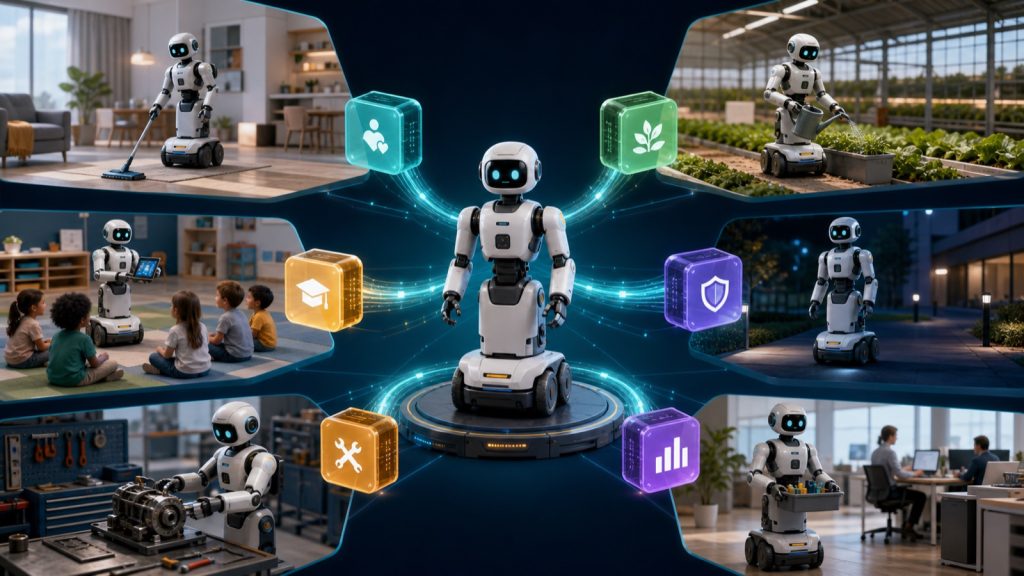
Elon Musk’s vision of abundance depends on more than intelligent software. AI must gain reliable, affordable bodies that can work in the physical world. The breakthrough may arrive when robots stop being single-purpose machines and become platforms: one mass-produced hardware base capable of installing, combining and updating professional skills.
From personal computer to personal robot
Early computers were specialist machines. Over time, standardized hardware and operating systems turned them into adaptable platforms. The same laptop can run accounting software in the morning, design tools in the afternoon and entertainment applications in the evening. Its value comes not only from the device, but from the software ecosystem it can support.
Robotics could follow a similar path. Instead of manufacturing a different machine for every profession, producers could build a dependable base robot at enormous scale: common joints, hands, cameras, microphones, mobility, batteries and onboard computing. Its role would be determined by certified AI skill packages rather than permanently fixed at the factory.
The defining robot of the future may not be the machine that performs one task best, but the affordable platform that can safely learn many tasks.
What an installable robot skill would contain
A robot skill package would be more complex than installing Word or Excel. Software for a physical machine must interpret an unpredictable environment, control movement and avoid harming people or property. It would need several coordinated layers.
Professional knowledge
Procedures, standards, terminology and decision rules for a defined role.
Physical policies
Pretrained movement capabilities for grasping, walking, carrying, inspecting and using tools.
Environment adapters
Maps, equipment profiles and local calibration for a particular home, farm, school or workshop.
Safety boundaries
Permission limits, prohibited actions, escalation rules and auditable human oversight.
The first installation would supply a broad capability. The robot would then need supervised orientation: learning where objects belong, which doors it may open, how a specific machine behaves and when it must ask for help. Updates could improve the skill without replacing the hardware, much as software extends the useful life of a computer.
One machine, several roles
The strongest economic case may be multi-role use. A household robot could perform routine cleaning, support an older person with reminders and fetching items, and help children practise lessons—within carefully separated permissions. A small farm could use one platform for crop inspection, measured watering, inventory movement and night-time perimeter monitoring. A workshop could switch between parts handling, visual inspection and guided maintenance.
Not every role should be treated as interchangeable. Teaching involves judgement, motivation and safeguarding. Care requires dignity, empathy and clinical boundaries. Security functions require restraint, privacy and clear legal accountability. The realistic near-term model is therefore assistance and augmentation, not unrestricted replacement.
A composable system could activate only the capabilities approved for a location and user. A care module might access medication schedules but not financial records. A school module could explain curriculum content but be blocked from private household data. The hardware remains shared; identities, permissions and data stay deliberately separated.
The technology is beginning to point in this direction
This vision remains speculative, but several building blocks are emerging. NVIDIA’s open Isaac GR00T N1 was designed as a customizable foundation model for generalized humanoid reasoning and skills. Its architecture combines deliberate visual-language reasoning with a faster action system for physical movement.
Open robotics ecosystems are also becoming more modular. Hugging Face LeRobot supports multiple robot bodies, pretrained policies, datasets and deployment workflows. Its plugin approach already resembles the beginnings of a compatibility layer between hardware and learned behaviour.
These systems are not yet an app store for complete professions. Real-world reliability, dexterity, battery life, cost and safety remain substantial challenges. But the direction is important: general hardware, shared foundation capabilities and task-specific adaptation are beginning to converge.
Why standardized hardware changes the economics
Special-purpose robots are expensive partly because development and manufacturing costs are spread across a narrow market. A common platform could distribute those costs across homes, farms, hospitals, schools and businesses. Component suppliers could optimize around shared interfaces, repair networks could stock common parts and training investments could reach a much larger installed base.
Manufacturing scale
Common components and large production volumes reduce unit cost.
Longer useful life
New software capabilities extend hardware instead of requiring replacement.
Shared innovation
Developers build skills for a platform rather than designing an entire robot.
Flexible utilization
One machine creates value across different tasks and times of day.
The operating system matters as much as the robot
A robot platform would need an operating and governance layer that separates skills, controls permissions and continuously monitors safety. Each skill should declare the sensors, tools, data and physical actions it requires. High-consequence capabilities should need stronger certification and explicit human authorization.
There would also need to be hardware abstraction: a common way for skills to request actions even when robot models have different arm lengths, hands or mobility systems. Before deployment, simulation and local testing would verify that a policy works safely on that specific machine in that specific environment.
Cybersecurity becomes physical security. A compromised spreadsheet can expose information; a compromised robot can move through a building and manipulate objects. Signed software, secure boot, encrypted data, automatic isolation and visible emergency controls would be foundational—not optional premium features.
A new marketplace—and new policy questions
If professional skill packages become products, organisations may purchase capabilities rather than recruit only for hours of labour. Developers, universities and industry bodies could create certified modules for local crops, curricula, equipment and languages. This could make advanced capability accessible to smaller organisations and underserved regions.
It would also create difficult questions. Who is liable when a downloaded skill causes damage? Can a robot owner inspect or transfer a trained capability? Who owns the operational data that improves it? How do societies prevent a few platform companies from controlling access to essential physical work?
The answer cannot be software alone. Interoperability standards, independent certification, worker transition programmes and clear rights around data and repair will shape whether adaptable robots broaden opportunity or deepen dependency.
The robot revolution may look more like a platform than a product
Mass-produced hardware combined with installable, composable AI skills could make useful robots dramatically more affordable. The opportunity is one dependable machine that grows into many roles. Achieving it will require open interfaces, rigorous safety, secure permissions and a deliberate commitment to human agency.
Perspective note: This article explores a possible evolution of physical AI. Current general-purpose robots and foundation models remain developing technologies; complete downloadable professions are not yet commercially mature.
Related perspectives

When Money Loses Meaning: What an AI-Abundant Economy Would Really Require
Elon Musk predicts AI and robotics could make money irrelevant by 2036. But abundance is not only a production problem—it is an access and…
Read article
Beyond Vibe Coding: Context Is the Real Competitive Advantage
AI can generate code quickly, but context determines whether that code solves the right problem and survives the real world.
Read article
Your Data Is Worth More Than You Think
The information already inside your organisation may reveal opportunities, risks and customer needs that remain hidden in everyday operations.
Read article